World Congress on Special Needs Education, Philadelphia


In late August I was lucky enough to travel to Temple University in Philadelphia to attend the World Congress on Special Needs Education. The conference was focussed on education for those with all varieties of special needs and the teachers’ perspective was a key component at this conference. It was really interesting and different to what I am used to, as in the past I have typically attended conferences with a largely cognitive psychology based audience. Understanding teachers’ perspectives is vital when carrying out work to inform educational approaches. Since the conference was held in Philadelphia, there were many American delegates that attended from across the states.

The first keynote talk really highlighted the role of cultural norms in education. The speaker was Prof. Cynthia Northington-Purdie, she provided a thoroughly engaging presentation. A big shock to me and many others, was that corporal punishment is legal and a normal part of the school system across various states in America, something that Prof. Northington-Purdie is passionate about changing. Nearly all countries in Europe along with many other countries across the world, are members of The United Nations ‘Convention on the rights of the child’, stating that children are to be protected from all forms of mental and physical violence, injury or abuse. Perhaps even more shocking are statistics on those with special needs also receiving corporal punishment in some states in America, and figures indicate that this often occurs even more regularly. This really highlights how culture shapes our perceptions, and the impact of these perceptions. This relates to ethical discussions that we also must have regarding issues of coercion and freedom of choice when carrying out research or teaching involving children with intellectual disabilities.

A really interesting talk was given by Prof. Estella De Los Santos on research carried out with associate professor Barba Patton, on the topic of teaching Maths, and the way the information is presented to the child. For instance, the way the question is framed to make it more relevant to the child. Prof. De Los Santos provided an example of a child who was confused and unable to answer when asked whether one number was bigger or smaller than another number. But, when asking the same child, ‘were you bigger when you were 6, or when you were 4?’ this was something that the child was able understand; responding ‘that’s easy, I was bigger when I was 6’. They also provided other instances whereby framing the questions with concrete examples that have relevance to the child can be very effective.

This nicely highlights the influence of the way that we ask questions, on the child’s ability to answer those questions. Children could also then transfer these new and helpful ways of framing or thinking about concepts for other questions. With regards to the DSL+ we have been working hard to devise creative routes to teach children about various aspects of vocabulary in ways that may help them to overcome specific areas of difficulty.

Another really interesting talk was given by Sudharsan Iyengar, he works as an IT programmer, but was approached by Christine Bothun who works in a School supporting children with Special needs. Christine was supporting a pupil who was both deaf and blind; it had been very challenging to help her to communicate. At the outset of the research the pupil was unable to communicate very basic requests such as when she would like to eat or drink. Helping the girl to develop a degree of autonomy was therefore an important goal. Sudhardsan developed a program whereby the girl heard novel sounds and was taught to associate these with objects. For example a certain sound would be presented when the girl was holding a cloth. Over time, the girl learnt to touch the cloth when she heard the sound associated with it. From there she could signal when she would like her face wiped, by pressing a button that made the sound. At this early stage it allowed the girl autonomy for basic everyday tasks, e.g., she was also able to signal when she would like to receive a drink. But, this is another nice example of generating alternatives to teach a child who is experiencing multiple challenges.

I also really enjoyed a talk presented by Dorothée Furnon about the use of a telepresence Robot, allowing a student to move around the classroom environment from sitting in her hospital bed! The study presented by Dorothée aimed to assess how the use of the robot had an effect on teaching practices and learning. The student was able to see via a webcam on the robot while her face was also shown on the screen, and she could control the robot to move around the school from one classroom to another, and even to travel to the cafeteria to spend time talking with her friends at lunch time. The results were very positive showing that the teacher included the student in the classroom, asking her questions and checking that she understood. The students experience was also very encouraging, she felt fully included and had positive learning outcomes. Research such as this has a lot of obvious potential, allowing for children who may often need to be absent from school to continue as much as possible to be included in the learning environment with their peers. This offers a great route to prevent barriers in children’s opportunities to develop academically and socially when away from school for medical or other reasons. Currently options such as these are extremely expensive of course, but, the future holds many exciting technical advances. We have certainly attempted to keep up as much as possible with the relevant technical options available to us regarding apps and picture books, and what they may be able to bring to our project in the DSL+.

I also gave a presentation at this conference on work carried out with Kari-Anne Næss and Chris Jarrold; it was on the topic of pragmatic communication in children with Down syndrome. Successful communication relies not only on children’s language content and form, but also their pragmatic skills, such as understanding appropriate or inappropriate verbal/nonverbal language in different contexts. The results I presented were assessing whether children with Down syndrome tend to experience any particular strengths or weaknesses in different areas of pragmatics, as well as exploring what other abilities appear to be related to pragmatic communication skills or difficulties in children with Down syndrome. The presentation was well received.

To sum up, it was interesting to get an insight into the different perspectives teachers and researchers can bring to the table, but also the cultural differences as well as similarities in teaching, particularly for special educational needs.

- Liz - 
På rett vei


I dag er det frist for årsrapportering til NFR. Det betyr at det er tid for å stoppe opp å vurdere i hvilken grad det er avvik mellom prosjektets planer og gjennomføring. Vi har kun mindre avvik å rapportere som er knyttet til at innhenting av pristilbud på utviklingen av app’en vår har tatt lengre tid enn planlagt.

For øvrig er vi svært fornøyde med hva vi har å rapportere. Alle tekstene til billedbøkene er skrevet. De første bøkene er tegnet. Vi har gjort et grundig forarbeid for utviklingen av intervensjonen og andre pilotering vil bli gjennomført i inneværende semester. Hele 4 review-artikler er på gang og vi sammenfatter tidligere forskning på følgende områder: vokabularintervensjoner for barn med Down syndrom, visuell fungering hos barn med Down syndrom, visuelle virkemidler i billedbøker og i billedbokapplikasjoner. I tillegg har en liten spørreundersøkelse på gang for å innhente informasjon fra foreldre om barn med Down syndrom sin bruk av nettbrett. Vi håper gjennom denne undersøkelsen å få informasjon om hvordan vi best kan designe den tekniske applikasjonen slik at den støtter barnas erfaringer, motivasjon og utholdenhet, visuelle preferanser samt kognitive og fysiske/sansemessige utfordringer knyttet til bruk av nettbrett hos barn med Down syndrom.

Det pågående review-arbeidet og spørreundersøkelsen gir oss informasjon og kunnskap som er viktig for å utvikle en evidensbasert intervensjon, og vi ligger nå godt an til oppstart av datainnsamlingen i august 2016.

I tillegg til forberedelsesarbeidet med tanke på utviklingen av intervensjonen har vi skrevet publikasjoner på eksisterende data. Hva resultatindikatorer gjelder kan vi være godt fornøyde med vårt første år av prosjektperioden. Allerede før intervensjonen er ferdig utviklet har vi 2 internasjonale publikasjoner på høyt nivå, 6 oppslag i massemedia og 32 brukerrettede formidlingstiltak inklusive fremlegg på internasjonale konferanser. I tillegg har vi hatt to masterstudenter tilknyttet prosjektet som fikk godkjent sin masteroppgave i sommer. Vi har flere internasjonale artikler i review-prosess og altså enda flere artikler på gang.

Nå gjelder det å stå på videre for å sikre at intervensjonen vi utvikler er av høyeste kvalitet. Vi går et spennende halvår i møte med tanke på siste finpuss på intervensjonen, utvikling av de resterende billedbøkene, utarbeidelse av lærerveiledning og «kurspakker» for lærere og spesialpedagoger.

Vi vil la deg ta del i noe av arbeidet vårt og vil i en periode fremover derfor dele en kort review av en eksisterende artikkel hver uke. Artiklene vi presenterer vil i første omgang omhandle språkintervensjoner for barn med Down syndrom.

-Kari-Anne -

Down Syndrome Research Forum 2015

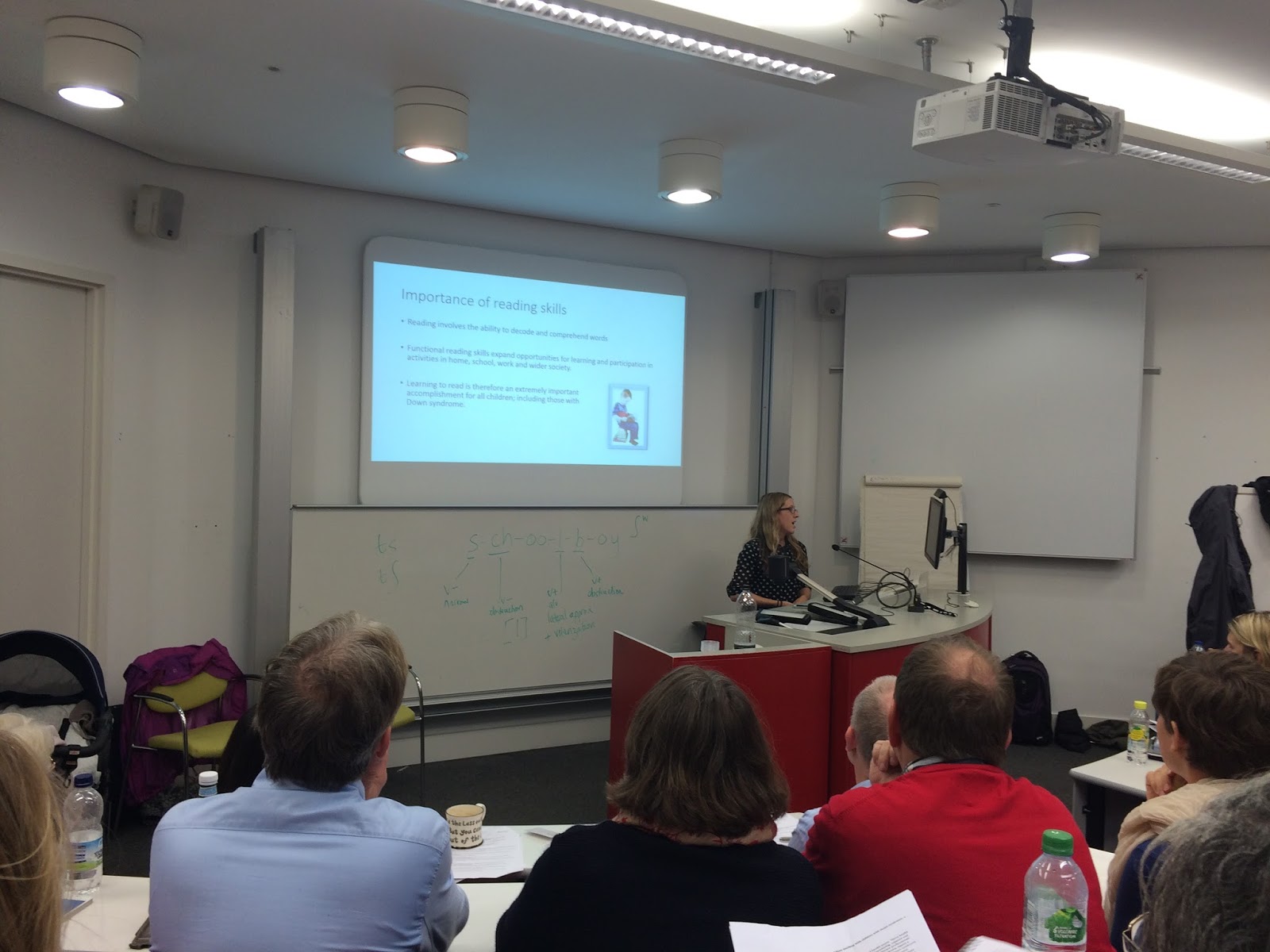
This year’s Forum meeting was hosted by University College London in the UK. The program for this meeting included a large variety of talks focusing on different areas of learning and development in children with Down syndrome. The keynote speaker, Professor Annette Karmiloff-Smith from the Birkbeck Centre for Brain & Cognitive Development at the University of London, focused on the importance of individual differences in understanding the Down syndrome genotype and phenotype.  In particular, the individual differences in genetics, brains, cognition and the environment were highlighted. Karmiloff-Smith and her team usually analyse the individual data from their larger group data base. Therefore, and because group data also may be positive for policy making, she did not reject finding trends but she argued the importance of investigating these individual differences and comparing them to other aspects of the individual child’s  profile. From a pedagogical perspective it has to be mentioned that three internal factors were mentioned in the key note but only one external factor. However, there are a range of additional possible external factors that were not mentioned in the talk but which may also possibly apply individual differences such as e.g. the teaching and intervention program used as well as different structural factors which may include type of support as well as the frequency, the duration and the quality of support. Interestingly, Karmiloff-Smith finalized her talk asking the question of whether fewer developmental trajectories may result in fewer individual differences rather than larger individual differences as suggested by earlier research. This keynote was really a very interesting talk which inspired the audience and which resulted in comments regarding individual differences in many other talks during the Forum meeting as well. I, therefore want to thank Karmiloff-Smith for her very inspiring talk and I also want to thank her for her active participation during the discussions throughout these two days.

I was also especially inspired by  a talk on shared book reading (Cain, Jeffery, & Burgoyne, in progress), and a talk on consolidation of new vocabulary learning in children with Down syndrome (Smith, Nash, Hayiou-Thomas, & Snowling, in progress). The knowledge revealed from these studies seems to be very relevant according to planning of the DSL+ intervention. So I really look forward to read their final publications.

From the DSL+-project we gave three talks during this year’s Forum meeting:
1)  Exploring the prevalence of reading skills in 6-8 year old children with Down syndrome: What characterizes those with early reading skills relative to those without? (Næss & Smith, in progress).
2) The social profile of 6 year old children with Down syndrome (Næss, Nygaard, Ostad, Dolva, & Lyster, in progress).
3) Questionnaires to inform app design for children with Down syndrome (Hokstad & Smith, in progress).


Actually, Silje did her first international talk at any conference today. She did a really great job and I was really proud of her. We do not usually have students that have the capacity to give a talk at an international “conference” like she did today. I look forward to follow her research career in the future.


Dinner - Tuesday evening
During the Forum meeting networking has also been important. We have had the opportunity to meet and talk to a lot of new people in the field; we have exchanged email addresses and other types of information for further conversation. Also, we have had some planned meetings during these days e.g. to discuss the systematic training part of our intervention with Kelly Burgoyne. To sum up, I think we have had some very interesting and fruitful days here in London, and I am already looking forward to the next Forum meeting that will be held in York, 5th -6th  September 2016.


Thanks a lot to Sue Buckley (Down syndrome Education International) and Professor Charles Hulme (University College London) for hosting the Down Syndrome Research Forum 2015!


-Written by Kari-Anne B. Næss-

Skriveseminar på Toten 13. – 18. september 2015


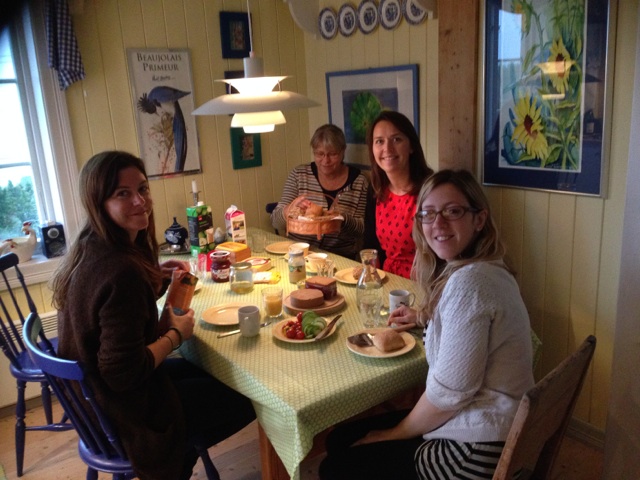
Uke 38 høsten 2015 er ei uke vi sent vil glemme. Etter en drøy times kjøretur nordover fra Oslo, kommer vi til Østre Toten og tar en stikkvei oppover i lia til Høibohagen. I porten foran et sjarmerende våningshus står Ingrid og ønsker velkommen. Et sted der også pelargonien «Dronning Ingrid» kneiser i potter og kasser. Vi samles rundt langbordet på kjøkkenet og gjør avtaler for uka som ligger foran oss. «Vi» er fem av de som jobber sammen i DSL+-prosjektet med et langsiktig mål for øyet: Å planlegge og gjennomføre en effektiv vokabularintervensjon for barn med Down Syndrom. Denne gangen er det Liz fra Universitetet i Bristol, Lovise, Ingrid og Anne Grethe fra Høgskolen i Telemark og Kari-Anne fra Universitetet i Oslo som deltar.

Det er flere oppgaver som står på programmet denne uka: Utarbeiding av undervisningsopplegg for studenter som skal bidra med utvikling av de digitale bildebøkene, planlegging av pilotering og en presentasjon til en internasjonal konferanse, foruten artikkelskriving.

Luftetur mellom skriveøktene
Værgudene var ikke på vår side denne gang. Det regnet «cats and dogs» som Liz uttrykte det. Men utsikten over Mjøsa omkranset av et av de mest fruktbare jordbruksdistrikter i Norge, var uansett utrolig vakker og skapte en ramme for oppholdet. Vi prøver å få en viss oversikt over den kunnskapen som allerede finnes på området. Artikler er under planlegging, «in progress» eller i sluttfasen.


Uten mat og drikke....
Våningshuset er også unikt i forhold til interiør. Her er det harmoni i farger og detaljer. Det gir inspirasjon til å samarbeide om mange detaljer som også må være på plass før utarbeiding av bildebøker og pilotering starter opp. Det blir lange dager med drøfting, ideutveksling og skriving under kyndig veiledning av prosjektleder Kari-Anne.


Vi reiser hjem og er takknemlige for at vi jobber i et prosjekt der kunnskap, kultur og vennskap kan bidra i et spennende forskningsprosjekt finansiert med FINNUT-midler. Planer for neste samling i oktober er allerede lagt.


- Skrevet av Anne-Grethe Mjøberg -


Research Assistant in DSL+


It`s July, it`s the beginning of the summer vacation and I find myself relaxing out in the sun with The Oxford Handbook of Quantitative Methods! I`m reading a chapter about research on “special populations” and I think I might have to write and share a summary. But first - what lead to this?


I have now finished the first year of my Masters in Intellectual disabilities at the Department of Special Needs Education at the University of Oslo. Leaving my job in special education to go back to school was a big leap. Now one year has past and going back to the University turned out to be exiting, challenging and enriching in so many ways. The studies are booth interesting and meaningful, and getting to be part of the DSL+-project is in   addition an amazing opportunity.


I was offered the job as research assistant a couple of months into my first semester. Now I`ve had some time to get to know the project and the people contributing in the project. Being part of a research team like this has a steep learning curve and the need to learn more is always present. At the same time this ”need” has roots in an eagerness to learn and understand more about an important and meaningful area of research. Knowledge about research methods within the behavioural sciences is important when working with earlier research done in the area of Down syndrome and language development as well as when conduction new research. Publications regarding different areas of importance for language development in children with Down syndrome are part of the groundwork of the project. One of my tasks as a research assistant is reference work with regards to these publications. In addition I get to contribute with some writing of my own.

Now we are doing preparations for the piloting of the intervention. This is something I`m really looking forward to be working on this autumn. My master thesis will be based on data collected during this piloting. The Department of Special Needs Education just opened for the opportunity to write the Master thesis as an article with an extended abstract. So for the time being the plan is to go for this option and (hopefully) be able to publish my article. The job in the DSL+-project has in this way had a big impact on my studies and perhaps also on my vocation after my studies.


With wishes for a great summer vacation!


Silje

Neurodevelopmental disorders seminar 2015 in Oxford

This year’s neurodevelopmental disorders seminar was held at the University of Oxford on 22nd June. It was a really well organised and enjoyable day. I was eager to attend the seminar day as it covers a diverse range of interesting topics that can be applied to many areas of neurodevelopmental research, prompting interesting discussions, particularly with regards to future directions.


This was my first visit to Oxford too. I got a nice glimpse of the city during a walk in the sunshine through the centre to the conference venue (picture shows bridge over canal just outside St. Catherine’s College where the seminar was held).  


There were two parallel sessions running throughout the day. I found some of the talks particularly interesting; Dr Sam Wass talked about executive function training early in infants’ development. The notion of targeting training very early in development is important in situations when it may be possible to train certain skills early on to support the child’s subsequent development. Such studies involve a number of obvious challenges relating to the practical difficulties of training skills or strategies in infants, and cognitive training is rarely focused on young infants so far. However, clever task designs can be used that do not require verbal or touch response. For instance, training children through providing rewarding stimuli (e.g., via visual salience) to encourage and direct eye movements and thus attention to certain components of the screen. The earlier one can intervene and attempt to address problem areas or enhance abilities, the more room there may be for potential positive knock on effects. Often in children with Down syndrome, the gap between them and their typically developing peers in cognitive performance widens over the course of development, so where it is feasible to attempt to enhance or train in infancy, it seems very positive to do so to support subsequent development. Relating this back to the DSL+ project, we are carrying out our vocabulary intervention when children start school at age 6. Once children start school there will be greater requirements for using their vocabulary and they will need new “academic” words in their vocabulary to support them in their school education.


A point was also raised about transfer effects, and the importance of hypotheses regarding where we would expect to see transfer effects, but also where we do not expect to see transfer effects. In a sense, this allows us to use training studies not only to directly improve the areas that we are training, but also as a form of basic science, i.e., as a useful route to teach us about the areas and processes that we are attempting to train.

Another talk that I found very interesting was by Dr Faye Smith, who discussed research on the consolidation of new vocabulary, this was specifically regarding children with dyslexia, but the key point was that regardless of their dyslexia and the different sleep patterns that tend to be experienced in this group, there remains a key role of sleep consolidation for learning. Again, relating this to our research, those with Down syndrome often have non-typical sleep patterns and some difficulties sleeping, but it is important that we take into consideration the important role of consolidation when we focus on children’s acquisition of new vocabulary items, as this may well play a strong role in children’s ability to learn the words. Allowing children to learn words on day one, and return the following day to re-familiarise themselves with the words, and to have repetition in the intervention over the course of multiple days is therefore an important component.

Another area that I felt had relevance to the DSL+ was a talk given by Dr Mary Hanley regarding classroom visual distraction in children with autism. The children with autism were particularly drawn to visual displays behind a teachers face.  It is important to consider not only the components included directly in the training materials, but also to consider the broader learning environment and the impact that this environment has on learning. With regards to visual distractions, this is something that we have thought carefully about in the design of the iPad tasks themselves. Of course, certain visual materials and colours can be aesthetically pleasing, but it is important that while material needs to engage the child, the visual information and backgrounds are not distracting and deterring children’s focus away from the learning task at hand. Other issues that are not controlled within the training tasks themselves, but rather involving the surrounding training environment may be important too. Clear instructions to teachers with examples of how to interact with the child to maintain their attention to the task at hand may be important to think about as well.


The final keynote talk from Prof. Dorothy Bishop was particularly engaging. A number of important issues to consider in this area of research were covered, among other things, the large variations from one child to the next in any group of individuals affected by a given neurodevelopmental disorder. This was also an important recurring point raised throughout the day, and is always an important consideration when attempting to study any given group.

Understanding group commonalities is extremely helpful, for instance, being aware that, at the group level, there is a common tendency for individuals with Down syndrome to experience weaknesses in areas such as verbal short-term memory, or expressive vocabulary. This helps us to devise specific interventions for those with certain disorders, and for instance in our intervention, to have an awareness of the heightened difficulties that we are likely to observe for many children with Down syndrome when we attempt to include expressive vocabulary tasks in our intervention (this can allow us to devise tasks in clever ways to help children overcome specific difficulties). However, individual differences are also very useful to be aware of, and are very informative regarding the neurodevelopmental disorders being studied. For example, not all children with Down syndrome have specific verbal short-term memory difficulties; understanding why there are some exceptions is important. In addition, awareness of individual differences can prevent us from attempting to apply one set of rules to an entire group of individuals. For our means, an element of flexibility is required in our intervention to allow for the inevitable scale of individual differences across children. For example, we are designing tasks in which children can respond verbally, or can respond with alternative forms of communication such as symbol or sign use where this is the only way for them to communicate and engage.


This seminar series really sparks a lot of important thoughts and discussion regarding methodology and theory that applies to various aspects of neurodevelopmental disorders research. Thanks to the organisers for a great day!

- Written by Liz Smith - 

DSL+ - webinar

Mest lest