 |
| Foto: Maria de Fatima Campos |

Conference on Communication in Individuals with Down Syndrome
The University of Oslo (the DSL+ project), in cooperation with Norwegian network for Down syndrome, the Norwegian Research Forum on Down syndrome and The National Library of Norway, invites you to an international conference on Down-syndrome and communication. The conference will be held at The National Library of Norway 31.08.17 and 01.09.17.
Program
AUGUST 31st
SEPTEMBER 1st

 |
| Illustration: Colourbox |
Program
AUGUST 31st
Time
|
Talk
|
09.00
|
Registration
|
10.00 – 10.30
|
Welcome
|
10.30 – 11.30
|
Charles Hulme:
Interventions to improve reading and language skills in children with Down
Syndrome
|
11.30 – 12.00
|
Silje Hokstad: Findings from a
systematic review of language interventions for children with Down syndrome
|
12.00 – 13.00
|
LUNCH (registered participants
only)
|
13.00 – 13.30
|
Christopher J. Lemons: Literacy
Instruction for Children with Down Syndrome
|
13.30 – 14.00
|
Kari-Anne Næss & Liz
Smith: Vocabulary, Phonological Awareness, and Letter Knowledge Promote
Reading in Children with Down Syndrome
|
14.00 – 14.30
|
Liv Inger Engevik, Kari-Anne B. Næss,
& Bente Hagtvet: Cognitive Stimulation of Pupils With Down Syndrome:
A Study of Inferential Talk During Book-Sharing
|
14.30 – 15.00
|
BREAK with picture book
exhibition
|
15.00 – 15.30
|
Ingrid Holmboe Høibo: Quality in newer wordless picture books |
15.30 – 16.00
|
Sara E Wood, Jennifer Wishart, Claire
Timmins, William J. Hardcastle, & Joanne Cleland: The use of
electropalatography (EPG) in the treatment of motor speech disorders in
children with Down’s syndrome: A randomized controlled trial.
|
16.00
|
Conclusion
|
18.00
|
Reception Oslo City Hall (registered
participants only)
|
SEPTEMBER 1st
Time
|
Talk
|
09.15 – 10.15
|
Ann Kaiser: Toward a Phenotypic Specific Early Communication Interventions
for Children with Down Syndrome
|
10.15 – 10.30
|
BREAK
|
10.30 – 11.00
|
Liz Smith, Silje Hokstad, &
Kari-Anne Næss: A systematic review of language
interventions for children with Down syndrome: what are the most effective
approaches?
|
11.00 – 11.30
|
Bernadette Witecy: Language comprehension in children, adolescents and adults
with Down syndrome
|
11.30 – 12.00
|
Field of practise in 90 min
Line Avers: When working on speech - can we be more concrete?
Nina Skauge: New
booklets make the difficult a little easier
|
12.00 – 13.00
|
LUNCH (registered participants only)
|
13.00 – 14.00
|
Field of practise in 90 minutes,
cont.
Karianne Hjørnevik Nes: Inclusive education in fifth grade public school with
language as a basic skill
Britt-Hege Wærnes: Reading and learning intervention for children with Down syndrome from kindergarten to first grade.
Henrik Wærnes: Systematic speech intervention with the Karlstadmodel
stimulation plate- a practice story
Karen Knudsen Synnes: Why sign-language is a key to communication and participation to people with Down Syndrome
Ellen Romstad: From reading and writing to communicating – in
and outside the classroom
|
14.00 – 14.30
|
BREAK with picture book exhibition
|
14.30 – 15.00
|
Kari-Anne Næss, Egil Nygaard, Johanne
Ostad, & Sol Lyster: Vocabulary
in children with Down syndrome
|
15.00 – 15.30
|
Anne-Stine Dolva, Marit Kollstad,
& Jo Kleiven: Language and communication
characteristics - teens as informants in research
|
15.30 – 16.00
|
Conclusion and the future in Down
syndrome research
|
For further information about the conference see :
My Academic Summer - Randomisation, Confidence Intervals and Forest Plots
Today I visited the Psychology Departement at Cardiff University for a crash course in statistics with Craig Hedge, PdD in experimental psychology. Craig is currently working on a Meta-analysis on reliability studies in cognitive control and is the go to guy when you are struggling with statistics. Liz and I had a few specific requests; we wanted to know how Craig carries out randomisation procedures using MatLab, we wanted him to explain confidence intervals and when to use them and we wanted to learn us about forest plotts.

Randomisation: Craig has previously carried out the randomisation procedures for the DSL+-project. When carrying out a Randomised Controlled Trial (RCT) the participants are randomly placed in either a experimental group or a control group. The process of group placement is called randomisation and should always be done by a third party not involved in the study of question. Neither me nor Liz knew how this procedure was actually carried out, and therefore asked Craig to show us. Using MathLab this turns out to be a relatively straight forward procedure. Knowledge that might come in handy one day!
 |
| Before it got complicated... |
If you use IQ as an example the average of the population is 100. If you tested the IQ of a sample of 30 people you might get a confidence interval of 93 - 103. If you repeated the procedure with another sample of 30 people you might get a confidence interval of 98 - 110. If you did this 100 times, you would expect the confidence interval to contain the true value (100, population mean) 95 times. The remaining five times would then have a confidence interval not containing the true value (100, population mean), e.g. 101 - 111.
You can read about confidence intervals in the article; The fallacy of placing confidence in confidence intervals (Morey, Hoekstra, Rouder, Lee and Wagemakers, 2016).
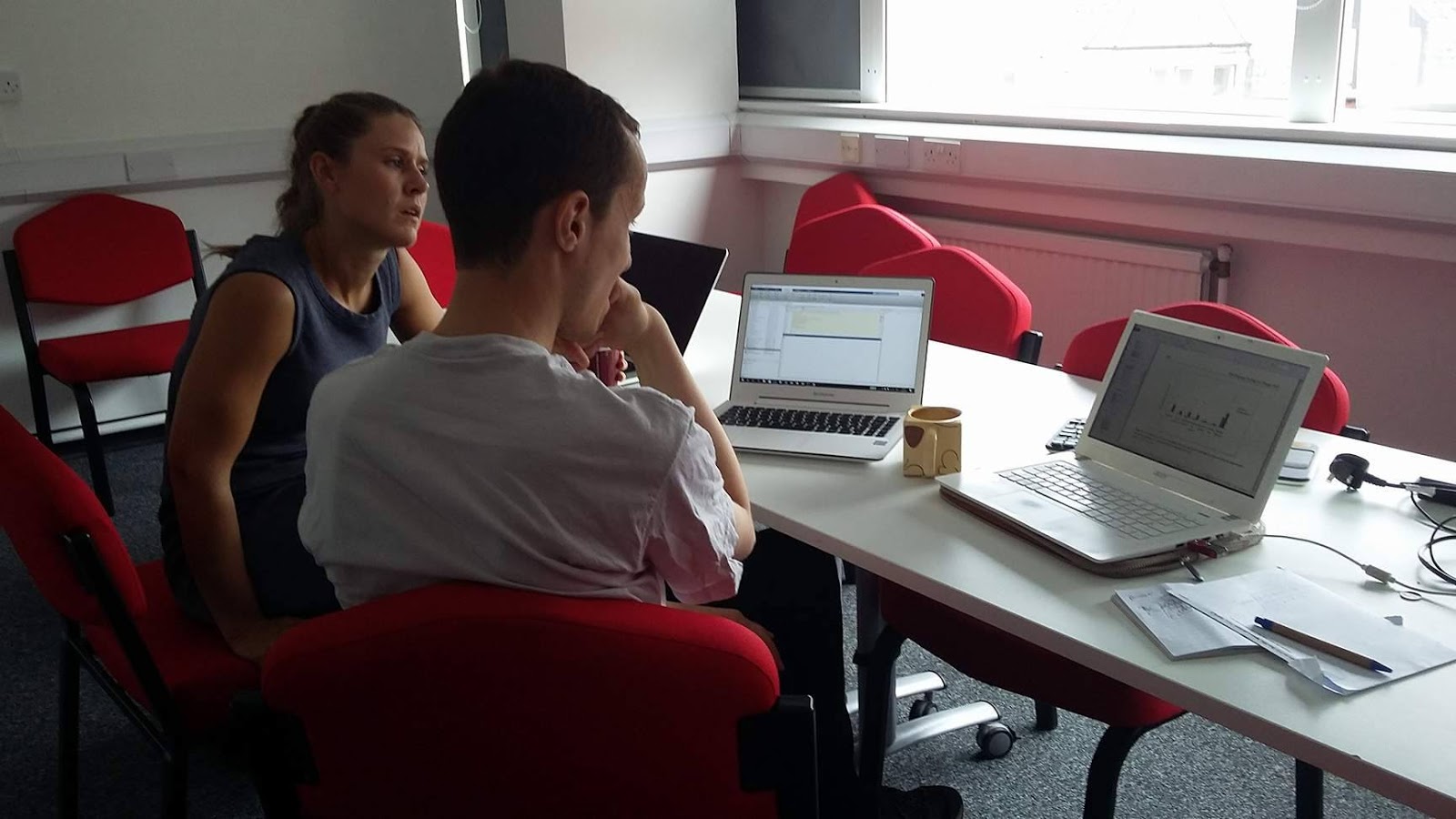 |
| The face of confusion.... |
So how can confidence intervals be used? One example is when presenting results from a meta-analysis using a forest plot. Two things to take from this is a) if the confidence interval goes through the vertical "0" line the results of the studie is non significant and as such b) if the confidence interval is on the right side of the vertical "0" line the results of the studie is significant. The diamond in the bottom is the average mean of all the included studies.
 |
| Illustration image, Wikipedia commons |
Thanks to Craig Hedge for having us visit!
- Silje and Liz -
My Academic Summer
As
I wrote about in one of my blog posts a while ago, I have been so fortunate as to receive a travel
grant from The Ryoichi Sasakawa Young Leaders Fellowship Fund (SYLFF). This
grant is used for a two-week research stay at the University of Bristol, England. As I write this I am at the beginning of my two-week stay in England and I have two exiting and eventful weeks ahead of me. Amongst other things I will be presenting the DSL+-project focusing on my masters project on implementation at the School of Experimental Psychology at the University of Bristol and at the Departement of Psychology at Bournemouth University.
 |
| The First Day of My Academic Summer - Cardiff Bay |
As such this summer will be something out of the ordinary!
I will keep you posted...
With the best wishes for the summer
- Silje -
Abonner på:
Innlegg (Atom)

Mest lest
-
 We were so lucky to have Kelly Burgoyne visiting in August. Her visit were supported by The ESRC International Centre for Language and Commu...
 -
 The results of the randomized trial of the DSL+ vocabulary intervention program is now published in Remedial and Special Education. Read the...
 -
 Silje and Kari-Anne received funding from UiO: Life Science to conduct a two-week Research stay at Peabody College of Vanderbilt University...
 -
6. Mars var Logopediens dag. Årets tema var Alternativ og Supplerende Kommunikasjon. I artikkelen Lær barn som mangler talespråk sosiale...
