Down Syndrome Research Forum 2015

This year’s Forum meeting was hosted by University College London in the UK. The program for this meeting included a large variety of talks focusing on different areas of learning and development in children with Down syndrome. The keynote speaker, Professor Annette Karmiloff-Smith from the Birkbeck Centre for Brain & Cognitive Development at the University of London, focused on the importance of individual differences in understanding the Down syndrome genotype and phenotype.  In particular, the individual differences in genetics, brains, cognition and the environment were highlighted. Karmiloff-Smith and her team usually analyse the individual data from their larger group data base. Therefore, and because group data also may be positive for policy making, she did not reject finding trends but she argued the importance of investigating these individual differences and comparing them to other aspects of the individual child’s  profile. From a pedagogical perspective it has to be mentioned that three internal factors were mentioned in the key note but only one external factor. However, there are a range of additional possible external factors that were not mentioned in the talk but which may also possibly apply individual differences such as e.g. the teaching and intervention program used as well as different structural factors which may include type of support as well as the frequency, the duration and the quality of support. Interestingly, Karmiloff-Smith finalized her talk asking the question of whether fewer developmental trajectories may result in fewer individual differences rather than larger individual differences as suggested by earlier research. This keynote was really a very interesting talk which inspired the audience and which resulted in comments regarding individual differences in many other talks during the Forum meeting as well. I, therefore want to thank Karmiloff-Smith for her very inspiring talk and I also want to thank her for her active participation during the discussions throughout these two days.

I was also especially inspired by  a talk on shared book reading (Cain, Jeffery, & Burgoyne, in progress), and a talk on consolidation of new vocabulary learning in children with Down syndrome (Smith, Nash, Hayiou-Thomas, & Snowling, in progress). The knowledge revealed from these studies seems to be very relevant according to planning of the DSL+ intervention. So I really look forward to read their final publications.
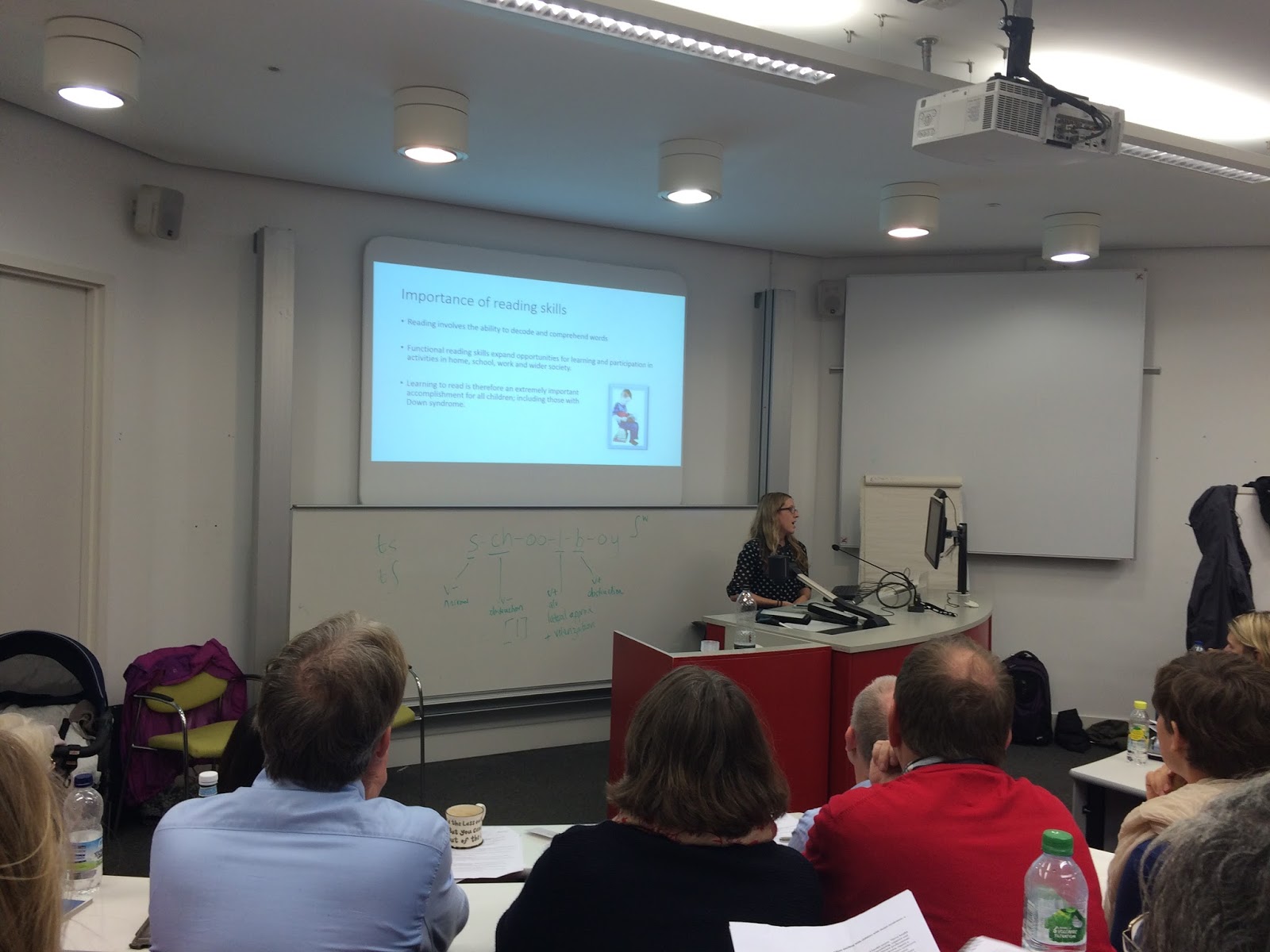
From the DSL+-project we gave three talks during this year’s Forum meeting:
1)  Exploring the prevalence of reading skills in 6-8 year old children with Down syndrome: What characterizes those with early reading skills relative to those without? (Næss & Smith, in progress).
2) The social profile of 6 year old children with Down syndrome (Næss, Nygaard, Ostad, Dolva, & Lyster, in progress).
3) Questionnaires to inform app design for children with Down syndrome (Hokstad & Smith, in progress).


Actually, Silje did her first international talk at any conference today. She did a really great job and I was really proud of her. We do not usually have students that have the capacity to give a talk at an international “conference” like she did today. I look forward to follow her research career in the future.


Dinner - Tuesday evening
During the Forum meeting networking has also been important. We have had the opportunity to meet and talk to a lot of new people in the field; we have exchanged email addresses and other types of information for further conversation. Also, we have had some planned meetings during these days e.g. to discuss the systematic training part of our intervention with Kelly Burgoyne. To sum up, I think we have had some very interesting and fruitful days here in London, and I am already looking forward to the next Forum meeting that will be held in York, 5th -6th  September 2016.


Thanks a lot to Sue Buckley (Down syndrome Education International) and Professor Charles Hulme (University College London) for hosting the Down Syndrome Research Forum 2015!


-Written by Kari-Anne B. Næss-

Skriveseminar på Toten 13. – 18. september 2015


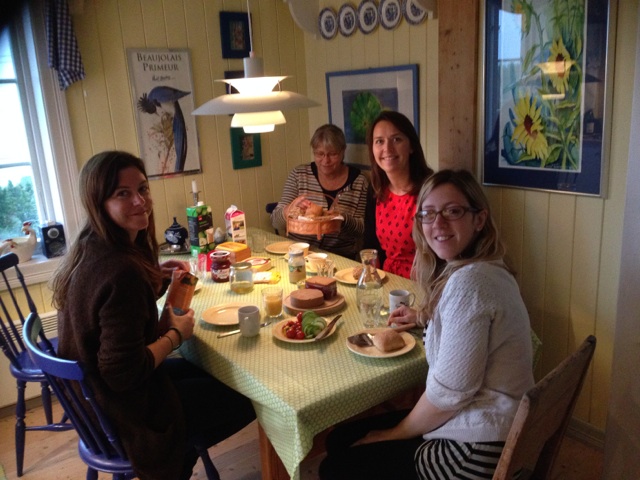
Uke 38 høsten 2015 er ei uke vi sent vil glemme. Etter en drøy times kjøretur nordover fra Oslo, kommer vi til Østre Toten og tar en stikkvei oppover i lia til Høibohagen. I porten foran et sjarmerende våningshus står Ingrid og ønsker velkommen. Et sted der også pelargonien «Dronning Ingrid» kneiser i potter og kasser. Vi samles rundt langbordet på kjøkkenet og gjør avtaler for uka som ligger foran oss. «Vi» er fem av de som jobber sammen i DSL+-prosjektet med et langsiktig mål for øyet: Å planlegge og gjennomføre en effektiv vokabularintervensjon for barn med Down Syndrom. Denne gangen er det Liz fra Universitetet i Bristol, Lovise, Ingrid og Anne Grethe fra Høgskolen i Telemark og Kari-Anne fra Universitetet i Oslo som deltar.

Det er flere oppgaver som står på programmet denne uka: Utarbeiding av undervisningsopplegg for studenter som skal bidra med utvikling av de digitale bildebøkene, planlegging av pilotering og en presentasjon til en internasjonal konferanse, foruten artikkelskriving.

Luftetur mellom skriveøktene
Værgudene var ikke på vår side denne gang. Det regnet «cats and dogs» som Liz uttrykte det. Men utsikten over Mjøsa omkranset av et av de mest fruktbare jordbruksdistrikter i Norge, var uansett utrolig vakker og skapte en ramme for oppholdet. Vi prøver å få en viss oversikt over den kunnskapen som allerede finnes på området. Artikler er under planlegging, «in progress» eller i sluttfasen.


Uten mat og drikke....
Våningshuset er også unikt i forhold til interiør. Her er det harmoni i farger og detaljer. Det gir inspirasjon til å samarbeide om mange detaljer som også må være på plass før utarbeiding av bildebøker og pilotering starter opp. Det blir lange dager med drøfting, ideutveksling og skriving under kyndig veiledning av prosjektleder Kari-Anne.


Vi reiser hjem og er takknemlige for at vi jobber i et prosjekt der kunnskap, kultur og vennskap kan bidra i et spennende forskningsprosjekt finansiert med FINNUT-midler. Planer for neste samling i oktober er allerede lagt.


- Skrevet av Anne-Grethe Mjøberg -


Research Assistant in DSL+


It`s July, it`s the beginning of the summer vacation and I find myself relaxing out in the sun with The Oxford Handbook of Quantitative Methods! I`m reading a chapter about research on “special populations” and I think I might have to write and share a summary. But first - what lead to this?


I have now finished the first year of my Masters in Intellectual disabilities at the Department of Special Needs Education at the University of Oslo. Leaving my job in special education to go back to school was a big leap. Now one year has past and going back to the University turned out to be exiting, challenging and enriching in so many ways. The studies are booth interesting and meaningful, and getting to be part of the DSL+-project is in   addition an amazing opportunity.


I was offered the job as research assistant a couple of months into my first semester. Now I`ve had some time to get to know the project and the people contributing in the project. Being part of a research team like this has a steep learning curve and the need to learn more is always present. At the same time this ”need” has roots in an eagerness to learn and understand more about an important and meaningful area of research. Knowledge about research methods within the behavioural sciences is important when working with earlier research done in the area of Down syndrome and language development as well as when conduction new research. Publications regarding different areas of importance for language development in children with Down syndrome are part of the groundwork of the project. One of my tasks as a research assistant is reference work with regards to these publications. In addition I get to contribute with some writing of my own.

Now we are doing preparations for the piloting of the intervention. This is something I`m really looking forward to be working on this autumn. My master thesis will be based on data collected during this piloting. The Department of Special Needs Education just opened for the opportunity to write the Master thesis as an article with an extended abstract. So for the time being the plan is to go for this option and (hopefully) be able to publish my article. The job in the DSL+-project has in this way had a big impact on my studies and perhaps also on my vocation after my studies.


With wishes for a great summer vacation!


Silje

Neurodevelopmental disorders seminar 2015 in Oxford

This year’s neurodevelopmental disorders seminar was held at the University of Oxford on 22nd June. It was a really well organised and enjoyable day. I was eager to attend the seminar day as it covers a diverse range of interesting topics that can be applied to many areas of neurodevelopmental research, prompting interesting discussions, particularly with regards to future directions.


This was my first visit to Oxford too. I got a nice glimpse of the city during a walk in the sunshine through the centre to the conference venue (picture shows bridge over canal just outside St. Catherine’s College where the seminar was held).  


There were two parallel sessions running throughout the day. I found some of the talks particularly interesting; Dr Sam Wass talked about executive function training early in infants’ development. The notion of targeting training very early in development is important in situations when it may be possible to train certain skills early on to support the child’s subsequent development. Such studies involve a number of obvious challenges relating to the practical difficulties of training skills or strategies in infants, and cognitive training is rarely focused on young infants so far. However, clever task designs can be used that do not require verbal or touch response. For instance, training children through providing rewarding stimuli (e.g., via visual salience) to encourage and direct eye movements and thus attention to certain components of the screen. The earlier one can intervene and attempt to address problem areas or enhance abilities, the more room there may be for potential positive knock on effects. Often in children with Down syndrome, the gap between them and their typically developing peers in cognitive performance widens over the course of development, so where it is feasible to attempt to enhance or train in infancy, it seems very positive to do so to support subsequent development. Relating this back to the DSL+ project, we are carrying out our vocabulary intervention when children start school at age 6. Once children start school there will be greater requirements for using their vocabulary and they will need new “academic” words in their vocabulary to support them in their school education.


A point was also raised about transfer effects, and the importance of hypotheses regarding where we would expect to see transfer effects, but also where we do not expect to see transfer effects. In a sense, this allows us to use training studies not only to directly improve the areas that we are training, but also as a form of basic science, i.e., as a useful route to teach us about the areas and processes that we are attempting to train.

Another talk that I found very interesting was by Dr Faye Smith, who discussed research on the consolidation of new vocabulary, this was specifically regarding children with dyslexia, but the key point was that regardless of their dyslexia and the different sleep patterns that tend to be experienced in this group, there remains a key role of sleep consolidation for learning. Again, relating this to our research, those with Down syndrome often have non-typical sleep patterns and some difficulties sleeping, but it is important that we take into consideration the important role of consolidation when we focus on children’s acquisition of new vocabulary items, as this may well play a strong role in children’s ability to learn the words. Allowing children to learn words on day one, and return the following day to re-familiarise themselves with the words, and to have repetition in the intervention over the course of multiple days is therefore an important component.

Another area that I felt had relevance to the DSL+ was a talk given by Dr Mary Hanley regarding classroom visual distraction in children with autism. The children with autism were particularly drawn to visual displays behind a teachers face.  It is important to consider not only the components included directly in the training materials, but also to consider the broader learning environment and the impact that this environment has on learning. With regards to visual distractions, this is something that we have thought carefully about in the design of the iPad tasks themselves. Of course, certain visual materials and colours can be aesthetically pleasing, but it is important that while material needs to engage the child, the visual information and backgrounds are not distracting and deterring children’s focus away from the learning task at hand. Other issues that are not controlled within the training tasks themselves, but rather involving the surrounding training environment may be important too. Clear instructions to teachers with examples of how to interact with the child to maintain their attention to the task at hand may be important to think about as well.


The final keynote talk from Prof. Dorothy Bishop was particularly engaging. A number of important issues to consider in this area of research were covered, among other things, the large variations from one child to the next in any group of individuals affected by a given neurodevelopmental disorder. This was also an important recurring point raised throughout the day, and is always an important consideration when attempting to study any given group.

Understanding group commonalities is extremely helpful, for instance, being aware that, at the group level, there is a common tendency for individuals with Down syndrome to experience weaknesses in areas such as verbal short-term memory, or expressive vocabulary. This helps us to devise specific interventions for those with certain disorders, and for instance in our intervention, to have an awareness of the heightened difficulties that we are likely to observe for many children with Down syndrome when we attempt to include expressive vocabulary tasks in our intervention (this can allow us to devise tasks in clever ways to help children overcome specific difficulties). However, individual differences are also very useful to be aware of, and are very informative regarding the neurodevelopmental disorders being studied. For example, not all children with Down syndrome have specific verbal short-term memory difficulties; understanding why there are some exceptions is important. In addition, awareness of individual differences can prevent us from attempting to apply one set of rules to an entire group of individuals. For our means, an element of flexibility is required in our intervention to allow for the inevitable scale of individual differences across children. For example, we are designing tasks in which children can respond verbally, or can respond with alternative forms of communication such as symbol or sign use where this is the only way for them to communicate and engage.


This seminar series really sparks a lot of important thoughts and discussion regarding methodology and theory that applies to various aspects of neurodevelopmental disorders research. Thanks to the organisers for a great day!

- Written by Liz Smith - 

Guest lecture by Margaret Tresch Owen at the Department of Special Needs Education, UiO


I little while ago I attended a guest lecture held by professor Margaret Tresch Owen from University of Texas – Dallas. The topics of the lecture were predictors in language and concept development. In the longitudinal study, NICHD Study of Early Child Care and Youth Development 1990 – 2007, Owen and colleges examined the effects of early child care on over 1300 children. One of the domains examined was trajectories for language functioning later in life. Interaction between parent and child was recorded and analysed. Amongst other things the video material from this study has been used to examine the predictors of vocabulary size at age three, as well as the correlation between vocabulary size and literacy skills in third graders.

Owen talked about how vocabulary size is accumulative – the more words you know, the more words you learn. This also means that the gap between children’s vocabulary size increases quickly in the early years. However, vocabulary size isn`t the only factor of importance in predicting language and literacy skills further on. Margaret says that the vocabulary size has gotten the most attention, but the sole focus on words is not enough. The path toward language starts very early and children’s emerging skills (gestures, vocalizations and joint attention skills), and in their research they have found that caregivers child-directed speech and their shared communication foundation are all predictors of vocabulary at age 3.

In the in depth study, Quality of Early Communication, video material from the NICHD - project, Owen and colleges examined the quality of the dyadic communication between mother and child. They selected 60 low income children from the longitudinal study, including both successful and struggling language learners. The quality of the mother-child interaction was coded within three categories:

o   Symbol infused joint engagement
·      How well does the child actively sustain attention to a shared activity that includes symbols as well as objects and events? Raters focused on the child`s active interest and attention, as well as the parent`s contribution.
o   Fluent and connected communication
·      Assessment of the overarching flow and cohesion of the mother-child interaction. Raters attended to the balance between partners`contributions.
o   Playful routines and rituals
·      Assessment of the frequency and quality of routines and rituals that occurred during shared activities. Raters attended to the dyads coordinating of activity using a familiar play routine or a cultural script.
(Hirsh-Pasek et al., 2015)

Findings from the study is resently published in the article; The Contribution of Early Communication Quality to Low-Income Children`s Language Success (Hirh-Pasek et al., 2015). The study shows significant correlations between quality in the mother-child communication in the child’s first year and language functioning later on in life. Communication foundation qualities matters - hence filling the word gap won’t be enough in early intervention. Building a strong foundation for communication is needed.

- Silje Hokstad - 

References

Hirsh-Pasek, Adamson, Bakeman, Owen, Golinkoff, Pace, . . . Suma. (2015). The Contribution of Early Communication Quality to Low-Income Children's Language Success. Psychological Science, 0956797615581493.

Inkludering, tilpassa læringsdialoger og kognitiv stimulering i arbeid med elever med Down-syndrom - ei multimetodisk tilnærming til undervising og læring

Dette er tittelen på avhandlingen til Liv Inger Engevik. Hun vil forsvare sin avhandling for graden Phd i auditorium 3 i Helga Engs hus på Blindern, fredag 26. juni 2015 kl. 12.15-ca kl. 15.00.

Bedømmelseskomitén har bestått av følgende personer:
Professor Bim Riddersporre, Fakulteten för lärande och samhälle, Malmö Högskola, Sverige (1. opponent).
Professor Kristine M. Jensen de Lopez, Institut for Kommunikation, Aalborg Universitet, Danmark (2. opponent).
3. medlem av bedømmelseskomitéen og komiteens koordinator er professor Bodil Stokke Olaussen, Institutt for pedagogikk, Det utdanningsvitenskapelige fakultet, Universitetet i Oslo.

Disputasen er åpen for alle interesserte og kan definitivt anbefales.
 

DSL+ - webinar

Mest lest